Businesses often assume that slow growth means they need more marketing campaigns. In reality, the challenge may be more specific: limited relevant demand, weak customer evaluation, poor conversion, or friction elsewhere in the buying journey.
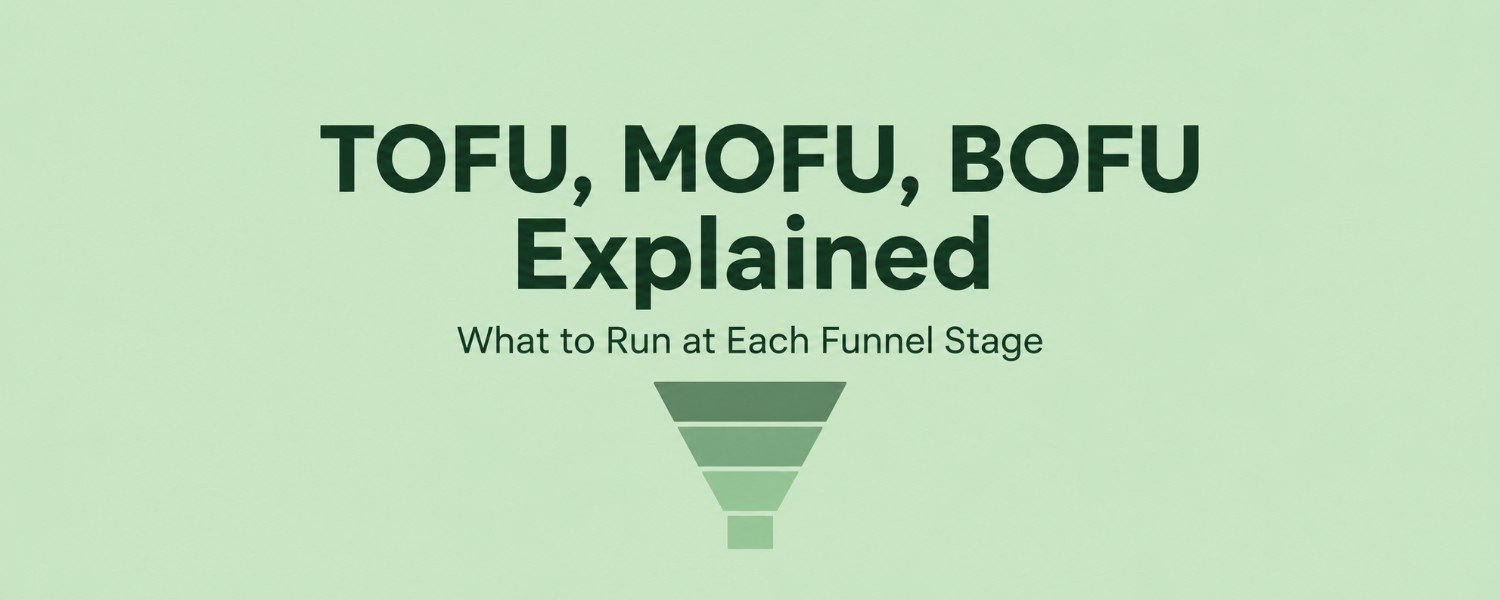
This is where TOFU, MOFU, and BOFU marketing can help identify where the constraint sits. TOFU builds awareness, MOFU supports evaluation, and BOFU helps drive the final commercial decision. But customers do not always move through these stages in a fixed order. They may compare options, revisit decisions, or move between stages-what Google calls the “messy middle” of the customer journey.
At Calibrate Commerce, the starting point is not simply choosing the next campaign. It is identifying which commercial constraint is limiting growth and where marketing can have the greatest impact.
TOFU, MOFU and BOFU are most useful when each stage is treated as a different customer and commercial problem rather than simply a media objective.
LinkedIn’s marketing funnel framework similarly connects customer progression with awareness, consideration and conversion.
The exact shape of the funnel depends on the business.
A startup still validating demand does not face the same commercial challenge as an established company entering another GCC market.
The useful principle is that customer questions generally become more specific as awareness turns into evaluation and action.
TOFU marketing helps build qualified awareness when a brand needs more relevant demand or stronger problem recognition. The right approach depends on what the audience needs to understand before they are ready to consider a solution.
The goal is not simply to reach more people. It is to reach people who could realistically need, afford, and choose the product.
If customers already know the brand but need more information before buying, more awareness will not solve the problem. As our paid social vs organic social guide explains, channel choices should follow the business need, not a fixed formula.
MOFU marketing helps customers evaluate their options when awareness exists but they are not yet ready to decide. The focus is on answering questions, reducing uncertainty, and building confidence.
Useful MOFU content includes:
Think with Google describes the mid-funnel as a key stage where customers explore and evaluate their options.
Retargeting alone is not a MOFU strategy. Showing the same ad again creates another impression, but it does not necessarily answer a customer’s concerns.
When information is the main constraint, content marketing should help the right customers understand their options and move closer to a decision, rather than simply publishing more content.
BOFU marketing focuses on removing the final barriers to purchase when customers already show strong intent but are still not converting.
The barrier is not always price. It can be lack of trust, unclear pricing, delivery concerns, limited proof, implementation complexity, or a poor buying experience.
Useful BOFU activities include:
HubSpot describes the bottom of the funnel as the stage where qualified prospects compare specific solutions, pricing, and implementation details.
BOFU does not automatically mean offering a bigger discount. If traffic is strong but conversions are weak, conversion rate optimization may create more value than buying additional traffic.
Likewise, BOFU activity cannot create demand that does not exist. If too few relevant customers know the brand or understand the category, the priority should be higher in the funnel.
Yes. The same channel can support different funnel stages. What matters is the audience, message, customer need, and commercial goal, not the platform itself.
For example:
What changes across the funnel is the audience, message, offer, destination, and objective.
Our full-funnel social media marketing guide explains how paid, organic, creator, community, and customer experience activity can work together as one connected growth system.
Content should change according to the customer’s current question when information, understanding or confidence is preventing progression.
The same topic can support different funnel stages depending on the intent and action behind the content.
Formats should not be classified mechanically. A case study, for example, can support MOFU education or BOFU validation depending on its purpose.
When discoverability is the main constraint, SEO, AEO and GEO can also help customers find and evaluate useful information earlier in the journey.
There is no universal TOFU, MOFU and BOFU budget split.
The budget should follow demand, business maturity, the sales cycle and the current commercial constraint.
The right marketing approach also depends on the business stage. As a company grows, its main constraint can change:
Increasing media spend before the wider business can support additional demand can become an expensive scaling mistake.
Our D2C marketing guide explains how growth constraints can change as businesses mature.
Funnel performance should connect stage-specific indicators with downstream customer quality, revenue and profitability.
Marketing measurement can become disconnected from actual business performance when individual metrics are viewed in isolation.
High video views mean little if customers never move into consideration. Large lead volumes can also hide weak performance when most enquiries are rejected by sales. Similarly, high ROAS may look positive while margins remain low or results depend heavily on discounts and existing customers.
Acquisition should therefore be evaluated alongside repeat purchases, contribution margin, and customer lifetime value. A higher CAC can still support healthier growth when acquired customers generate stronger long-term value.
Reliable data analytics and commercial measurement should connect marketing signals with business outcomes rather than create another isolated dashboard.
Full-funnel strategies often fail when one unresolved commercial constraint weakens the stages around it.
Customer questions change as intent develops, so generic messaging rarely works across the full funnel.
Large audiences do not always create commercial value. Reach should focus on relevant potential customers.
Creating awareness and immediately asking for a purchase can leave customers without enough information or confidence to decide.
Discounts cannot replace trust, proof, strong positioning, or a good customer experience.
Media, content, CRM, ecommerce, sales, and operations can optimise different goals instead of the same customer journey.
Repeated exposure does not necessarily answer customer questions or remove buying objections.
Low CPMs, clicks, or lead costs can look efficient while failing to improve revenue quality.
Stopping measurement at acquisition can hide the impact of repeat purchases and customer lifetime value.
Start with the business constraint, not the campaign format. A practical full-funnel plan can follow five steps:
Identify where the customer journey is losing demand, confidence, conversions, or commercial value.
Set clear TOFU, MOFU, and BOFU objectives based on the business's current needs.
Identify what customers need to understand, compare, or believe before moving forward.
Align the audience, message, offer, landing experience, and next action.
Track whether relevant customers progress and whether that progress creates profitable outcomes.
The right solution may involve positioning, content, paid media, pricing, CRO, analytics, CRM, technology, customer experience, or operations.
The goal is not to optimize every channel at once. It is to identify the commercial constraint limiting growth and apply the right expertise to solve it.
TOFU means top of funnel, where customers first discover a problem, opportunity, category, or brand.
MOFU means middle of funnel, where customers evaluate solutions and compare alternatives.
BOFU means bottom of funnel, where high-intent customers compare specific products or providers before taking action.
Educational and problem-awareness content can help build relevant demand among potential customers.
It can be, if it helps answer evaluation questions. Repeating the same awareness ad is not enough.
There is no fixed percentage. The budget should reflect business maturity, sales cycle, demand, and the current commercial constraint.
Sustainable growth does not come from simply doing more marketing. It comes from identifying the right commercial constraint and applying the right expertise to solve it.
Calibrate Commerce assesses whether the challenge sits in:
From there, the right combination of strategists, marketers, analysts, ecommerce specialists, and technologists can be brought in to address the specific challenge.
The goal is not to optimize every funnel stage at once. It is to solve the constraint that matters now, measure the impact, and address the next one as the business grows.
Build a full-funnel growth strategy with Calibrate Commerce or request a marketing funnel performance audit.
Sources