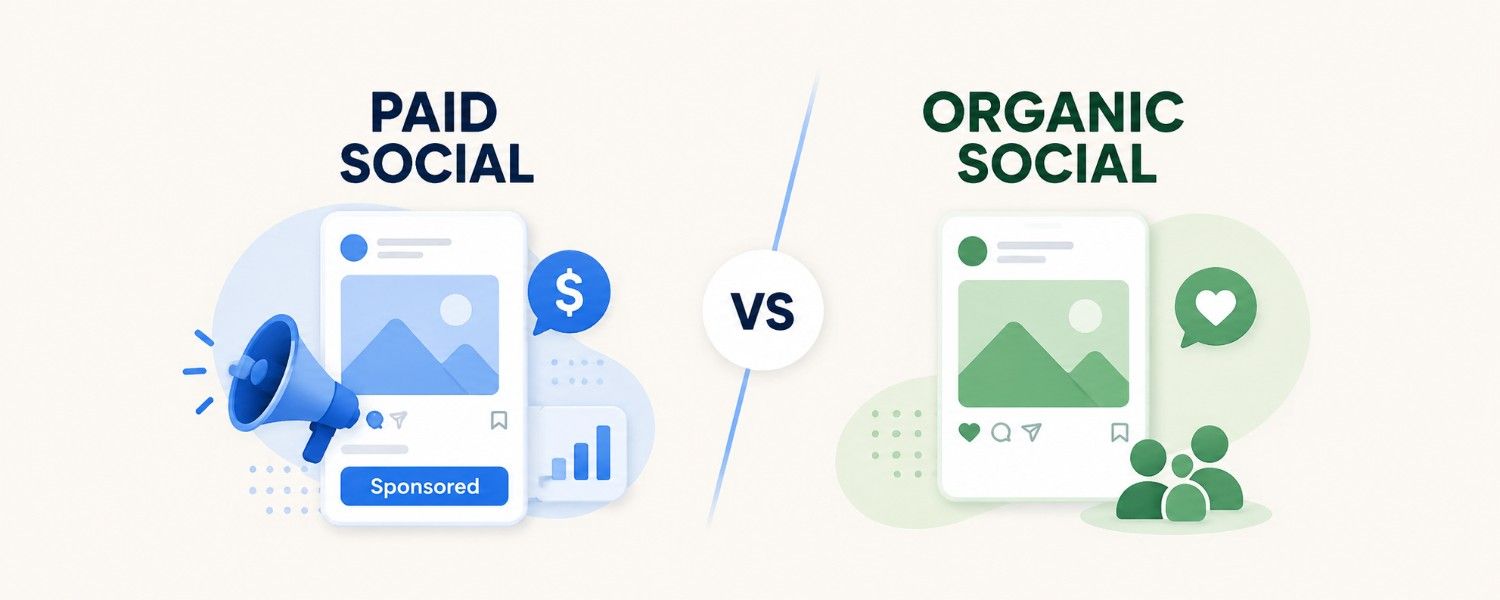
Businesses often debate paid social vs organic social as if choosing the right channel will solve the growth problem. In practice, the channel is rarely the real issue.
At Calibrate Commerce, we see businesses face different commercial constraints. A business may need more reach when positioning is unclear, stronger content when the offer needs refinement, or better conversion when the website is failing to turn existing demand into customers.
Organic social builds relevance, proof and creative insight, while paid social advertising provides controlled distribution, testing and customer acquisition.
The right media strategy and investment should follow the commercial constraint preventing the business from reaching its next stage of growth."
The real question is not which channel is better. It is what role each should play in the growth system.
Meta distinguishes organic reach from paid reach based on whether distribution happens without or with paid promotion. LinkedIn also describes paid and organic content as complementary parts of a wider strategy.
Give each channel a clear commercial role.
Many businesses invest in organic social media because they believe they need to post more often. But posting frequency is rarely the real objective.
Organic social becomes commercially useful when it helps businesses:
Organic social is not free. It requires strategy, content production, community management and specialist time.
The better question is: Is organic activity helping customers understand, trust and choose the business?
Businesses often increase paid social media spending when growth slows. This works when limited distribution is the real constraint, but wastes money when the problem lies elsewhere.
Paid social advertising across Meta, Facebook, Instagram, TikTok, LinkedIn and Snapchat can support:
However, more distribution cannot fix weak positioning, poor pricing, low demand or fulfilment issues.
A common mistake is increasing ad spend before understanding why existing demand is not converting.
When the commercial fundamentals are working, paid social can accelerate profitable customer acquisition.
The goal is not more traffic. It is more of the right customers at sustainable economics.
There is no universal paid-to-organic budget split. The allocation should follow the constraint limiting growth.
Fixed ratios can hide the real business problem.
A brand with high engagement may still have weak commercial demand. Another may have strong paid performance but insufficient creative supply.
Ask instead: Will the next unit of investment remove the most important constraint to growth?
The same strategy does not fit every stage.
Early-stage companies should not assume more exposure will prove product-market fit.
Growing businesses may already have demand but face creative fatigue, rising customer acquisition cost, fulfilment limits or weak retention.
At scale, operations, inventory, customer experience and commercial economics must support additional demand.
The right organic and paid social strategy should evolve with the business.
A major performance gap appears when content and media teams learn separately.
Paid and organic social should operate as one commercial learning system.
Start with the business problem, not the channel.
Is the constraint awareness, positioning, trust, distribution, conversion or retention?
Without diagnosis, good platform metrics can still lead to the wrong decision.
Use organic posts to test customer questions, demonstrations, objections, hooks and formats.
Look beyond likes. Watch time, saves, shares, meaningful comments and product questions can reveal stronger signals.
Adapt promising ideas for paid distribution and creative testing.
A successful organic post may still need a clearer value proposition or call to action.
LinkedIn supports turning organic posts into paid promotions to extend reach to selected audiences.
Paid results should not stay inside an advertising dashboard.
They can reveal which messages attract better customers, which products create demand and which objections prevent conversion.
Feed those insights into organic content, landing pages, offers and positioning.
Once one problem improves, another may become the bottleneck.
A business may solve distribution and expose conversion. It may improve conversion and uncover retention.
The system should keep diagnosing, testing, learning and reallocating.
Calibrate Commerce's full-funnel social media approach applies the same principle: paid, organic, creative and data work better when connected around the customer journey and business outcomes.
High engagement does not automatically mean high commercial value.
A popular post may attract reactions without influencing purchase behaviour. A product demonstration with fewer reactions may answer a serious buying question.
Before content amplification, look for retention, relevant comments, saves, shares and product interest.
Then check whether the product, landing page, fulfilment, tracking and usage rights can support additional demand.
Meta's partnership ad tools also show how creator content, often sourced through the right influencer partnerships, can move from organic influence into paid distribution.
The goal is to scale content that supports a commercial objective.
One of the most common budgeting mistakes is treating media spend as total social investment.
The cost is broader.
Organic requires people and production. Paid requires creative supply. Analytics depends on reliable data. Conversion may require ecommerce, technical or commercial expertise.
That is why social media budget allocation should separate media, content, technology, people and testing costs.
The right marketing metrics and data tracking are useful only when they help leadership make better business decisions.
We rarely evaluate return on ad spend (ROAS) in isolation.
A lower ROAS may support a healthier business if customers purchase repeatedly and generate stronger lifetime value. A high ROAS may still be unattractive when margins, fulfilment or customer quality are weak.
Ask: Did the combined social system generate more profitable customer demand and move the business towards its next stage of growth?
Most mistakes happen when teams optimise activity instead of the business.
Begin with diagnosis, not a media plan.
Identify whether growth is limited by positioning, demand, trust, distribution, conversion, operations, retention or measurement.
Clarify what must change for the business to reach its next stage.
Content expertise may be needed when relevance is weak. Performance media may matter when distribution is constrained. Ecommerce, analytics or conversion rate optimisation expertise may matter when customers arrive but do not buy.
Measure whether changes improve customer behaviour and commercial outcomes, not only channel KPIs.
Successful businesses solve the most important constraint, then identify the next one.
The paid-organic split should evolve rather than remain fixed.
Organic social builds relevance, proof and customer insight without paid distribution. Paid social uses media investment for controlled reach, testing and customer acquisition.
Neither is universally better. The right emphasis depends on the business stage, commercial objective and growth constraint.
There is no universal amount. Investment should reflect demand, unit economics, conversion readiness, creative capacity and fulfilment ability.
No. Organic social requires strategy, production, community management, tools and specialist time, even without a media fee.
Only selectively. Amplify content with relevant audience and commercial signals rather than automatically promoting the post with the most likes.
Measure each according to its role, then connect performance to acquisition, conversion, retention, revenue, customer value and profitability.
Businesses rarely need more marketing everywhere.
The paid social vs organic social decision is therefore not a channel choice. It is an allocation decision around the current commercial constraint.
A company may believe it needs paid social when positioning is the constraint. Another may invest in content when limited distribution is holding back demand. A third may acquire customers but lose growth through conversion, fulfilment or retention.
Calibrate Commerce starts by identifying the constraint, then brings together the expertise required around one growth objective.
The goal is not to maximise advertising spend, posting frequency or individual marketing metrics. It is to improve the performance of the business.
Successful businesses grow by identifying the right commercial challenge at the right time, solving it systematically and adapting as the next constraint emerges.
That is the role of Calibrate Commerce: applying the right expertise to the challenge preventing the next stage of growth.