Businesses rarely have an SEO, AEO or GEO problem in isolation. They usually face a discoverability or commercial growth constraint that appears through search.
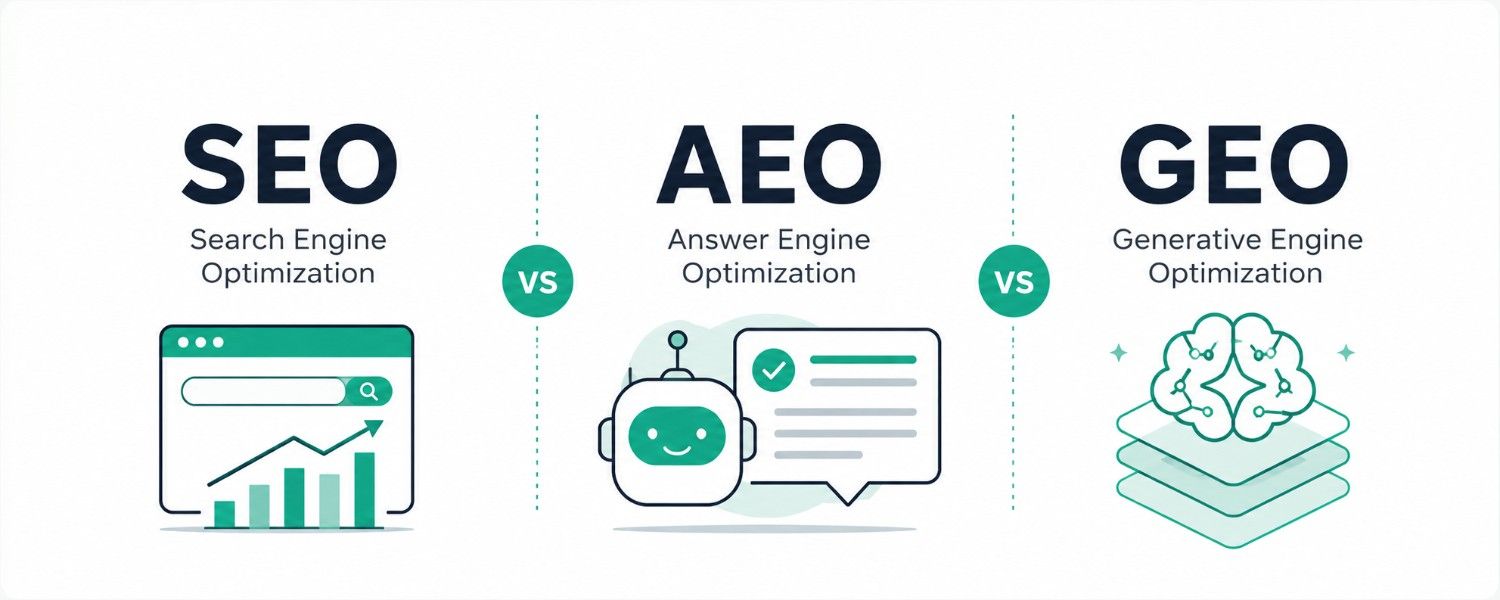
SEO supports traditional search visibility, AEO helps search engines and assistants identify clear answers, and GEO helps brands become understood and referenced within generative AI experiences.
But choosing between them should not start with the acronym. It should start with the business problem.
A technically inaccessible website or generic content can limit visibility across search and AI platforms.
The objective is not three separate optimization programmes. It is one search visibility system supporting qualified demand, customer confidence and commercial growth.
At Calibrate Commerce, we first identify the constraint and then apply the expertise needed to address it.
The biggest difference is where each approach improves discoverability and how that visibility supports customer decisions.
These boundaries are useful, but they are not absolute. SEO, AEO and GEO share many of the same foundations, including technical accessibility, useful content, authority, clear information and consistent business entities.
Google also confirms that established SEO practices continue to apply to AI Overviews and AI Mode.
A new search format does not necessarily mean a new commercial problem. The underlying constraint may still be technical accessibility, weak positioning, poor content or limited authority.
One of the most common mistakes we see is choosing a tactic before identifying the constraint.
A traffic decline does not automatically mean more SEO content. Low AI visibility does not necessarily require a GEO programme. Weak conversions do not always call for more acquisition.
The first question should be:
What is preventing customers from finding, understanding or choosing the business?
The answer may involve search visibility, but it could also sit within positioning, customer experience, product information, pricing or conversion.
Stronger rankings will not fix an unclear value proposition. More traffic will not repair a difficult buying experience. More AI citations will not solve inaccurate product information.
The right intervention depends on where the commercial journey is breaking and the stage of business growth.
Businesses often assume SEO is simply a way to generate more organic traffic. That view is too narrow.
Search engine optimization improves a website’s ability to be discovered, crawled, indexed and ranked for relevant searches.
SEO can include:
Its commercial value goes beyond rankings. The businesses that see real results are the ones that connect rankings to revenue rather than tracking them in isolation. Important pages may not be indexed, valuable categories may be difficult to discover, or content may attract visitors without supporting buying decisions.
That is why SEO should also be measured through:
At Calibrate Commerce, SEO is treated as part of a broader growth system. We first identify whether discoverability is limiting growth, then apply the right combination of SEO, content, analytics and technical expertise.
Businesses often create useful information that customers never receive in a clear enough format.
That is where Answer Engine Optimization (AEO) can help. AEO structures information so search engines and assistants can identify and surface useful answers to specific questions. New to the concept? Our guide, What Is AEO?, breaks it down in more detail.
Common AEO approaches include:
These formats can support featured snippets, voice search and AI-assisted search.
However, AEO is not simply adding dozens of FAQs to a website. The underlying information still needs depth, credibility, context and technical accessibility.
The better question is not:
“How many questions can this page answer?”
It is:
“Which customer questions are preventing people from moving forward?”
AEO becomes valuable when businesses answer those questions clearly at the right stage of the customer journey.
Many businesses now want visibility inside generative AI responses. The mistake is assuming GEO begins with manipulating AI systems.
It does not.
Generative Engine Optimization (GEO) focuses on how a business is discovered, understood and represented within generative experiences.
GEO can involve:
However, GEO does not have one confirmed set of universal ranking factors. Different AI systems use different models, sources, retrieval methods and prompts.
The commercial objective should therefore be accurate and credible representation, not simply chasing tactics for getting cited in AI Overviews and ChatGPT answers.
Being mentioned is not enough. The more important question is whether the business is represented accurately and recommended in commercially useful contexts.
Visibility without accuracy can create another business problem rather than solve one.
No. GEO does not replace SEO. Businesses should not abandon proven search foundations simply because generative search introduces new terminology.
SEO remains an important foundation for generative search visibility. Pages still need to be crawlable, indexable, useful and technically accessible.
Google has also stated that special files such as llms.txt are not required for visibility in its generative Search experiences.
The relationship is straightforward:
The right combination depends on the business constraint and stage of growth.
Most businesses do not need equal investment across SEO, AEO and GEO. They need to solve the constraint limiting their next stage of growth.
This approach prevents businesses from chasing terminology before solving the underlying commercial problem.
The constraint should determine the specialist intervention-not the latest search terminology.
Search requirements change as a business moves from validation to growth, scale and expansion. There is no universal SEO, AEO or GEO roadmap.
A startup may need to validate demand before investing heavily in visibility. A scaling business may instead need stronger infrastructure and operational capacity to support additional demand.
For expansion, markets such as the UAE and Saudi Arabia may require different languages, positioning and customer journeys.
The key is to make search strategy support the current commercial constraint, rather than follow a fixed SEO, AEO or GEO roadmap.
Ecommerce brands face a wider challenge than generating traffic. Search systems and customers need accurate, consistent product information.
Key foundations include:
For AEO and GEO, this information must remain current and consistent. Outdated prices or stock can damage customer trust as well as search visibility.
That is why we rarely recommend starting ecommerce GEO with citation tracking. Product and category accuracy should usually come first.
The same principle applies to conversion rate optimization. Strong product visibility with weak conversions does not always indicate an acquisition problem. The constraint may instead sit within pricing, checkout, delivery or product information.
Businesses often underestimate how different GCC search markets can be. The region should not be treated as one search audience.
Key differences can include:
A phrase performing strongly in Dubai may not reflect how customers search in Riyadh. This creates a commercial decision before it becomes an SEO decision:
Should the business translate, localise the proposition or create a different market experience?
Arabic SEO is therefore more than translating English copy. Products, pricing, delivery promises and customer expectations may all need to change - our guide on winning bilingual search across MENA covers this in depth.
At Calibrate Commerce, regional search strategy is considered alongside the wider expansion model, bringing together SEO, content, analytics and commercial expertise where needed.
The right approach depends on the market and the constraint limiting growth.
Businesses sometimes attempt advanced search tactics while basic foundations remain weak.
That usually creates complexity without solving the underlying problem.
Google continues to emphasise useful, original and people-first content for its AI experiences, alongside established SEO practices.
Good formatting can make strong information easier to understand and surface. It cannot compensate for weak expertise, inaccessible pages or unreliable claims.
Leadership teams often receive search reports full of metrics but little commercial meaning.
Rankings, citations and impressions are useful signals, but they are not the final business outcome.
These metrics are not interchangeable.
A citation may generate no meaningful traffic, while a single qualified organic visitor may generate significant revenue.
The goal is therefore to connect search visibility with customer quality, revenue and profitability-not simply to increase traffic or mentions.
Several common mistakes happen when businesses treat search as a marketing exercise rather than a connected business system.
These approaches share many of the same technical, content and authority foundations. Separating them can create duplicated work and conflicting priorities.
Generative search still depends heavily on established search foundations. Accessibility, relevance, technical quality and authority remain important.
More content does not automatically create more value. Businesses should focus on original, useful information that helps customers make decisions.
Question formatting alone cannot create useful answers. Strong AEO depends on genuine expertise, clear information and customer relevance.
AI visibility is more valuable when supported by genuine authority and credible third-party references.
Informational traffic has limited value when important product and service journeys remain weak. Search visibility should ultimately support commercially meaningful actions.
A business can appear frequently in AI responses and still be represented incorrectly. Visibility only creates value when the information is accurate and commercially useful.
The strongest approach begins with diagnosis rather than channel selection.
At Calibrate Commerce, the process can be viewed through five connected stages:
Identify what is limiting growth. The issue may involve search visibility, content, authority, conversion, product information, technology or customer experience.
Strengthen the systems that support discoverability, including technical SEO, information architecture, entity consistency and commercial page quality.
Identify the questions preventing customers from making confident decisions, using structured data such as schema markup where it helps clarify those answers. Create clear, credible answers where they matter most.
Support expertise with evidence, research, case studies and credible third-party sources.
Track rankings, answers, citations and mentions alongside traffic, leads, sales and customer value.
The objective is not to improve every metric.
It is to remove the constraint preventing the business from progressing.
SEO supports traditional search visibility. AEO helps information become easier to surface as direct answers. GEO focuses on representation within generative AI experiences.
AEO builds on strong search foundations by making useful information easier for search systems and assistants to understand.
No. Technical accessibility, useful content and authority remain important for generative search visibility.
Potentially. However, accurate products, categories, feeds and commercial information should usually come first.
Not necessarily. The right approach depends on the commercial constraint and expertise required to solve it.
Start with the issue limiting customer discovery or commercial progress. This could involve technical SEO, local visibility, answer clarity, AI representation or conversion.
Calibrate Commerce first identifies the commercial or discoverability constraint, then brings in the right SEO, AEO, GEO, content, analytics or technical expertise to address it.
When search visibility is not improving, customer discovery is changing or growth is being limited by a constraint that requires cross-functional commercial expertise. Calibrate Commerce starts with diagnosis rather than recommending a fixed marketing solution.
Businesses rarely struggle because they chose the wrong search acronym. They struggle because a constraint prevents customers from finding, understanding or choosing them.
That constraint may be technical SEO, content clarity, authority or AI representation. It may also sit outside search entirely-in positioning, conversion, customer experience, technology or commercial economics.
The objective is therefore not to improve SEO, AEO and GEO simultaneously. It is to identify and solve the constraint preventing the business from reaching its next stage of growth.
At Calibrate Commerce, the expertise applied changes with the challenge, bringing together search specialists, strategists, content teams, analysts, ecommerce experts and technologists where needed.
Businesses do not need more marketing. They need the right expertise applied to the right commercial challenge at the right stage of growth.