Full-funnel social media marketing is a strategic approach that connects social platforms across the complete customer journey, from awareness and consideration to conversion, retention, and advocacy.
Instead of using social media only for reach or only for direct response, brands integrate paid advertising, organic content, creators, community management, customer service, social commerce, and first-party data into one connected growth system.
Key characteristics of full-funnel social media marketing include:
For MENA brands, this approach is especially relevant. Customers use social platforms to discover products, compare options, communicate with businesses, make purchases, and share recommendations, often within the same session, on the same device, in two languages.
Most social media budgets in MENA are weighted toward the bottom of the funnel. Brands retarget website visitors, basket abandoners, and previous customers, repeatedly, until frequency rises, creative wears out, and the same small audience has seen the same message dozens of times.
Executing a full-funnel strategy requires consistent social media management to keep messaging aligned throughout the customer journey.
That is not a strategy. It is a loop.
Marketing leaders are increasingly being asked questions such as:
As digital maturity increases across MENA, many brands are exploring full-funnel models that align social media investment more closely with measurable business performance.
This guide explains:
The Mechanics of Bottom-Funnel Exhaustion
When brands invest only in conversion campaigns, three things happen simultaneously:
1. Audience fatigue: the same high-intent users see ads until engagement drops and CPAs rise
2. Algorithm narrowing: platform delivery systems learn only from existing converters, which narrows targeting and increases competition for the same impressions
3. Demand depletion: without awareness investment, the pool of warm prospects available for retargeting shrinks over time
Note: Awareness activity does not just build brand equity. It builds the audience pool that makes future performance campaigns efficient. Brands that cut awareness investment typically see CPA increases six to twelve months later, long after the budget decision that caused them.
Brands often strengthen full-funnel campaigns by combining social media with programmatic advertising to improve audience targeting.
Performance marketing captures demand that already exists. Awareness and brand activity create new demand. Both are necessary, but they operate on different timescales and should be measured differently.
Sustainable growth requires both. Brands that run only performance campaigns eventually exhaust their available audience. Brands that run only awareness campaigns fail to convert the interest they generate.
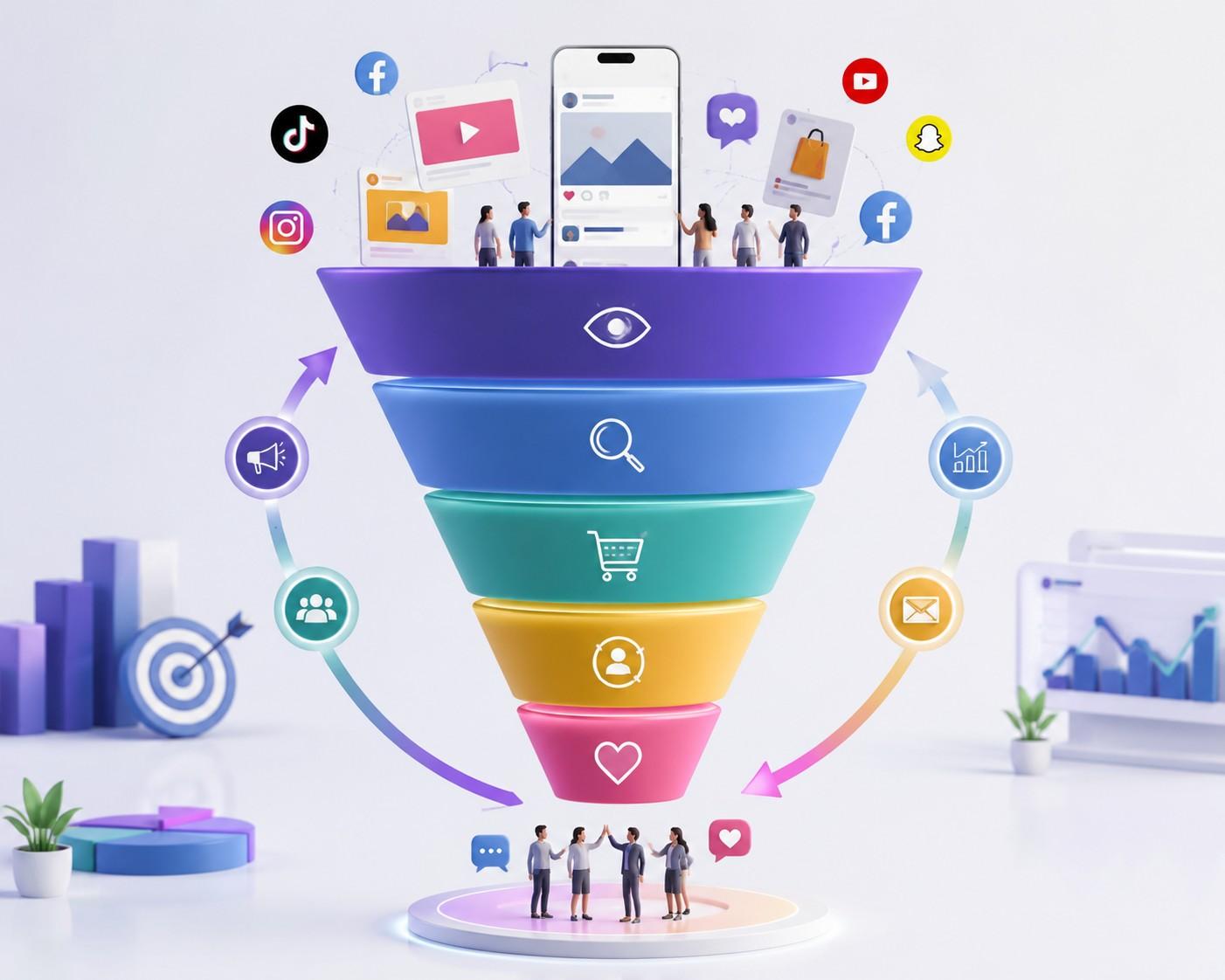
Rather than treating the funnel as a linear sequence of campaign objectives, Calibrate Commerce structures full-funnel social media as a continuous growth system with five connected stages. Each stage feeds the next, and the final stage, amplified, feeds back into the first.
The system is circular, not linear. Advocacy from retained customers reduces the cost of discovery for new ones. Brands that invest in Retain and Amplify stages lower their blended customer acquisition cost over time.
A full-funnel strategy is not the right answer for every business at every stage. It works best when the following conditions are in place:
What breaks the system:
1. Discover (Awareness)
The Discover stage reaches people who may not know the brand or recognise the need for its product. Its job is not to generate immediate sales, it is to introduce relevant potential customers into the system at a cost that makes later conversion economical.
Why awareness investment pays later: When a user encounters brand content at the Discover stage, they begin a learning process about the brand. When that same user later enters a retargeting pool, they convert at a higher rate and lower CPA than a cold audience would. The awareness investment has pre-qualified them. This is why brands that measure awareness only through last-click attribution consistently undervalue it.
Suitable content:
- Short videos and creator content
- Brand storytelling and cultural moments
- Educational hooks and problem-led messages
Useful measurements: qualified reach, audience penetration, video completion, profile visits, branded search growth, and lift in aided awareness.
2. Evaluate (Consideration)
At the Evaluate stage, customers know the brand and are assessing whether the offer is right for them. This is where most brands underinvest, leaving prospects without the information they need to move forward.
Why consideration content is the most neglected stage: Brands typically invest in making prospects aware, then immediately ask them to buy. The gap between awareness and purchase, which may involve reading reviews, comparing alternatives, watching tutorials, or asking questions, is left unaddressed. Brands that fill this gap with useful Evaluate content see higher conversion rates and lower CAC from their performance campaigns.
Suitable content:
- Demonstrations, tutorials, and comparisons
- Testimonials and creator reviews
- FAQs and user-generated content
Useful measurements: product views, engaged website visits, saves, message conversations, repeat visits, and qualified leads.
3. Decide (Conversion)
The Decide stage encourages high-intent users to complete a commercially valuable action — purchase, lead submission, appointment, application, subscription, or store visit.
Why the ad is only one part of conversion: Conversion performance frequently fails because of elements outside the ad, slow page load, poor mobile design, missing product information, unavailable stock, weak sales follow-up, or language inconsistency between ad and destination. Optimising the ad without optimising the destination is a common reason performance campaigns underdeliver.
Suitable content: product ads, promotional offers, dynamic product ads, customer proof, basket reminders, and clear calls to action.
Important measures: purchases, qualified leads, revenue, cost per acquisition, conversion rate, and average order value.
4. Retain
The funnel does not end after the first purchase. Retention activity increases repeat sales, product use, loyalty, and customer lifetime value.
Why retention changes the economics of acquisition: When customer lifetime value increases, acquisition cost tolerance also increases. A brand that retains customers for three years can profitably spend more to acquire each one than a brand that acquires customers once. Investment in retention is therefore also investment in acquisition efficiency, even though it appears in a different part of the budget.
Suitable content: onboarding guidance, usage tips, replenishment reminders, loyalty benefits, product recommendations, and exclusive content.
5. Amplify (Advocacy)
Advocacy occurs when satisfied customers actively recommend the brand through reviews, referrals, or content creation. This stage creates earned acquisition, new customers who arrive without a media cost.
Why advocacy reduces blended CAC: Every customer acquired through a referral or recommendation arrives without a paid media cost. In categories with high referral rates, advocacy activity can materially reduce blended customer acquisition costs. This is a financial outcome that belongs in board-level growth discussions.
Activities: referral programmes, review requests, customer spotlights, ambassador programmes, and UGC campaigns.
Platform advertising data published in DataReportal's Digital 2026 reports highlights significant differences between markets. These numbers represent potential advertising reach rather than verified monthly active users.
Source:
Saudi Arabia: Digital 2026: Saudi Arabia
UAE: Digital 2026: United Arab Emirates
Egypt: Digital 2026: Egypt
Three market-specific implications brands frequently get wrong:
1. Running Instagram-only campaigns in Egypt limits reach to under half the Facebook or YouTube audience
2. Ignoring Snapchat in Saudi Arabia ignores a platform reaching 91.8% of the eligible population
3. Treating the UAE as a single audience ignores the language, nationality, income, and intent differences that determine which platform performs by category
No platform has one fixed funnel role. Its value depends on the market, audience, category, format, and business objective.
Full-funnel social media marketing raises strategic questions that go beyond campaign management. The following are insights most relevant to CMOs, growth directors, and CFOs evaluating social media investment.
Awareness activity builds a trained audience pool that compounds over time. The value of that pool does not appear in impression cost, it appears in lower CPAs, higher conversion rates, and stronger performance from later-stage campaigns.
Judging an awareness campaign by its immediate ROAS is equivalent to judging a property investment by its first month's rental income.
The acquisition cost a brand can profitably sustain is directly determined by how much revenue a customer will generate over their lifetime. A brand with a 150 AED CLV cannot sustain a 50 AED CPA. A brand with a 1,500 AED CLV can.
Full-funnel social media that strengthens retention and advocacy improves CLV — which means the same acquisition campaigns become more profitable without changing a single ad.
Social media's influence on purchase decisions is not fully captured by click-based attribution. Brand awareness builds purchase intent that surfaces weeks later through direct search. Creator content influences decisions made in stores. Community engagement reduces churn without generating a trackable event.
A measurement framework for full-funnel social should include:
Successful full-funnel strategies require six connected components working as a system. Implementing only some of them produces partial results.
1. Customer Journey Mapping
Before building audiences, content, or campaigns, brands must understand how their specific customers actually move through the purchase journey — how they discover the category, what questions they ask, what prevents conversion, and what happens after purchase.
Useful insight sources:
2. Audience Architecture
3. Content Architecture
Content should have a defined role. One content asset should not be expected to perform every function simultaneously.
4. Paid and Organic Integration
Organic social builds credibility, conversation, and community. Paid social provides scalable reach, targeting, retargeting, and conversion optimisation. Strong organic content should be amplified through paid. Paid campaign performance should inform future organic content. Brands that manage these as separate workstreams lose the compound effect of their interaction.
5. Conversion Experience
The social media advertisement is one part of the journey. Conversion performance frequently fails because of:
Optimising the destination to match the social promise is as important as optimising the creative.
6. Measurement Framework
Most brands attempting full-funnel social media marketing make one or more of the following structural errors.
Myth 1: 80% Should Go to Conversion Campaigns
This rule exists because conversion campaigns are easier to measure, not because they produce the best return. In a healthy full-funnel system, the appropriate conversion investment is whatever efficiently converts the warm audience that awareness and consideration activity has built. If that pool is small, increasing conversion spend has diminishing returns.
Myth 2: Awareness Is Wasted Spend
Awareness is labelled wasted because it is difficult to attribute. That difficulty is a measurement problem, not an economic one. The customers who convert through retargeting were introduced to the brand somewhere. Eliminating awareness campaigns eliminates future retargetable audiences.
Myth 3: One Platform Is Enough
Single-platform strategies are a concession to resource constraints, not a strategic choice. In MENA, customer journeys cross platforms within a single purchase decision — discovery on TikTok, research on YouTube, purchase via Instagram.
A more useful principle: Budget should follow the customer, not the attribution model. Map how your specific customer discovers, evaluates, and buys. Allocate to match those stages rather than defaulting to a percentage rule that ignores your category, brand maturity, and available first-party data.
Full-funnel social media marketing typically performs well when:
1. Business objectives are clearly defined beyond media metrics
2. The customer journey is mappable from discovery through purchase
3. The brand has sufficient content production capacity across formats
4. Tracking and attribution infrastructure can support stage-specific measurement
5. Internal teams across marketing, sales, and data are aligned
Typical sectors where full-funnel social delivers strongest results:
Full-funnel social media marketing faces challenges when:
In these situations, fixing the fundamentals before scaling social investment produces better returns than expanding the media budget.
AI tools are changing how brands manage social media at every funnel stage, but they do not change the strategic structure of the funnel itself.
AI optimises within the objectives it is given. If those objectives are only conversion-focused, AI optimisation will optimise for conversion — at the expense of the wider funnel. Strategic direction must come before AI application, not after it.
Misconception 1: Running Multiple Campaign Objectives Creates a Funnel
Running awareness, traffic, and sales campaigns simultaneously does not constitute a full-funnel strategy. The campaigns must be connected through audiences, content sequencing, and measurement. Without connection, they are separate campaigns with separate results.
Misconception 2: Every Customer Moves Through the Funnel in Order
Customer journeys are rarely linear. People skip stages, return later, or convert after many interactions. A funnel is a model of average behaviour, not a guarantee of individual customer movement. Strategy should accommodate non-linear journeys.
Misconception 3: Organic Social Media Is Free
Organic distribution does not require a media fee. Strategy, content production, moderation, and community management still require resources. Treating organic as the zero-cost alternative to paid social usually produces zero-quality organic content.
Misconception 4: Every Brand Needs Every Platform
Platform selection should follow the customer journey and market data, not competitive anxiety. A B2B professional services firm in Saudi Arabia and a D2C skincare brand in Egypt require fundamentally different platform mixes.
Misconception 5: The Funnel Ends at Purchase
Retention, referrals, repeat purchases, and advocacy materially affect long-term profitability. Brands that measure social media success only through first-purchase ROAS are measuring a fraction of its commercial impact.
1. What business outcomes is social media expected to support — and are those outcomes measurable?
2. How does our specific customer actually discover, evaluate, and buy — not generically, but in our category and market?
3. Which platforms are dominant in each of our MENA markets, and does our platform mix reflect that data?
4. What does our content currently do well and at which funnel stage and where are the gaps?
5. How will we measure each stage independently, without applying ROAS logic to awareness investment?
6. What is our current customer lifetime value, and does our acquisition cost tolerance reflect it?
7. What happens after a customer makes their first purchase and is there a structured Retain and Amplify plan?
8. Does our conversion experience landing pages, mobile design, sales follow-up match the promise in our social ads?
9. Are our paid, organic, creative, and data teams connected or siloed?
10. What is the measurement horizon for each funnel stage, and is leadership aligned on it?
A. A strategy that guides customers from awareness to advocacy, using social media to drive long-term business growth.
A. No. Performance marketing focuses on conversions, while full-funnel marketing covers every stage of the customer journey.
A. It depends on the market. Instagram, TikTok, YouTube, Facebook, and Snapchat are the leading platforms across the MENA region.
A. They fail when brands focus only on conversions, disconnect funnel stages, or neglect customer retention.
A. Budget allocation should match business goals, brand maturity, and customer journey—not fixed percentages.
A. Because last-click ROAS often ignores the impact of awareness and consideration campaigns on conversions.
A. Yes. Influencers can build awareness, educate buyers, drive sales, and encourage customer loyalty.
A. Conversion campaigns can deliver results quickly, while brand-building typically takes 3–9 months.
A. Yes. It helps B2B brands generate leads, build trust, nurture prospects, and retain customers.
A. Measure awareness using reach, branded searches, engagement, video views, and direct traffic, not just sales.
Key Takeaways
Full-funnel social media marketing is unlikely to replace every advertising model, and brand building will remain essential for long-term growth.
However, as measurement capabilities continue to mature across MENA, full-funnel models are expected to become increasingly important for sustainable customer acquisition and retention.
The future is likely to be structured around three connected layers:
Brands that succeed will be those that combine strong measurement capabilities with connected strategy, aligned internal teams, and a clear view of how social media investment contributes to commercial outcomes not just media metrics.
Calibrate Commerce helps brands across MENA connect social media strategy, paid advertising, organic content, creators, technology, and customer experience.
We help brands:
We help MENA brands define funnel stages, structure audiences, develop content architecture, select the right platforms by market, and measure performance against business outcomes.