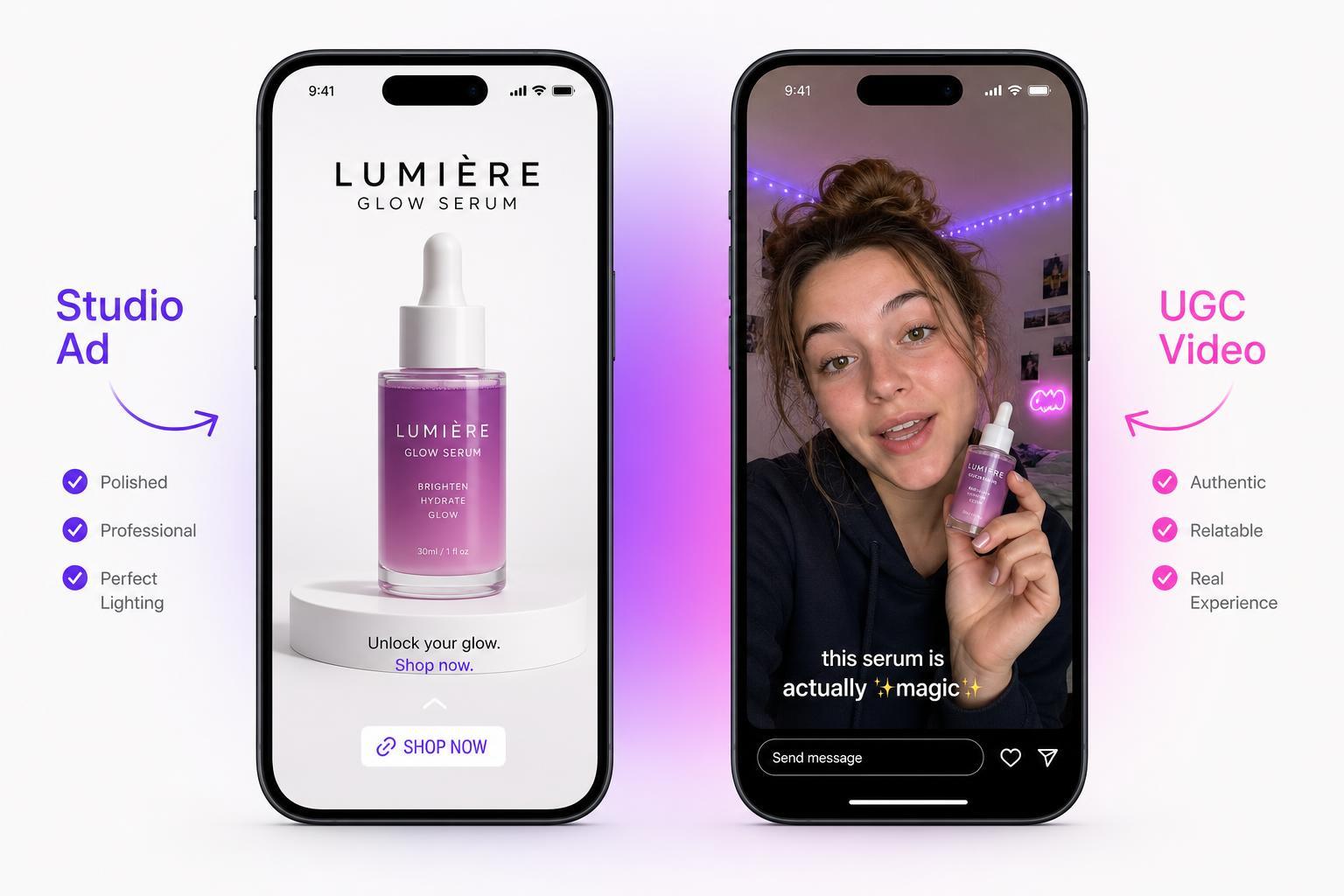
User-generated content (UGC) is content created by customers or creators that shows a product or service from a user's perspective, rather than through traditional brand advertising.
UGC can include product reviews, demonstrations, unboxing videos, testimonials, tutorials, customer experiences and creator-led product content.
It is different from branded content.
Branded content is created or controlled by the business to communicate its products, positioning and brand message.
UGC puts the product into a user's context.
The distinction matters because customers do not only need to know what a brand sells.
They also need to understand what using the product could look like for them.
For D2C brands, this makes UGC more than a social media format.
It can become a commercial asset across the customer journey.
One of the biggest opportunities for D2C brands is using creator content to help customers discover products they would not otherwise have considered.
A customer may not be actively searching for a new skincare product, fashion brand or household product.
They may discover it through a creator they already follow.
That first interaction can introduce:
This makes creator content particularly relevant to product discovery.
Traditional advertising can tell customers that a product exists.
UGC can show the product being used in a real context.
A skincare creator can demonstrate a routine.
A fashion creator can show how an item looks when worn.
A technology creator can demonstrate a feature or compare products.
A food creator can show how a product is used in everyday life.
The content helps move the customer from:
Discovery → Interest → Product Understanding
That is where UGC can create value before a customer even reaches a product page.
D2C brands are producing more content than ever.
But more content does not automatically create more customers.
A brand can have strong advertising, professional photography and polished messaging while customers still hesitate because they have unanswered questions.
They may want to know:
Creator content can provide another layer of evidence.
Instead of only telling customers what a product does, the brand can show the product through someone else's experience.
This creates a progression:
Discovery → Proof → Confidence → Consideration → Conversion
The commercial value of creator content therefore does not come simply from looking authentic.
It comes from helping customers understand and evaluate the product.
The choice does not need to be UGC versus branded content.
The two can perform different roles.
Branded content gives businesses control over:
UGC can add:
For example, a beauty brand might use branded content to communicate its product positioning and key ingredients.
Creator content can then demonstrate how the product fits into a daily routine.
Both pieces contribute to a stronger customer journey.
The strategic question is not:
“Should we replace branded content with UGC?”
It is:
“Where can creator content add information, credibility or context that branded content does not provide?”
That is a much more useful question for a growing D2C business.
UGC becomes commercially valuable when it does more than generate engagement.
Traditional advertising often presents a product from the brand's perspective.
Creator content can show the same product from the customer's perspective.
A creator can demonstrate how clothing fits, how skincare is applied, how an app works or how a product fits into a daily routine.
This helps customers visualise using the product themselves.
The objective is not simply to make the product look good.
It is to make the product easier to understand.
Customers often hesitate when they are uncertain about what they will receive after making a purchase.
Reviews, demonstrations and creator experiences can help reduce some of that uncertainty.
This is particularly useful for products where appearance, usability or performance is difficult to communicate through traditional advertising alone.
However, creator content only creates meaningful confidence when the creator is credible and relevant.
That is why creator selection matters as much as content production.
Creator content does not necessarily have to remain on the creator's profile.
Where the appropriate permissions and usage rights exist, strong creator assets can become part of the brand's wider paid media strategy.
They can be adapted for platforms such as TikTok, Meta and YouTube.
This gives businesses more creative inputs to test.
Instead of relying entirely on polished brand advertisements, businesses can test different creators, messages, demonstrations and customer perspectives.
The result is not simply more content.
It is more information about which messages and product demonstrations help customers move towards action.
Different creators can communicate the same product in completely different ways.
One creator may focus on convenience.
Another may focus on quality.
Another may demonstrate the product.
Another may address a common objection.
This can reveal:
That learning can influence wider acquisition, positioning and creative strategy.
The strongest creator content does not stop at engagement.
It helps customers understand enough about the product to take the next step.
That might mean:
Content → Product Research → Product Page → Basket → Purchase
Not every piece of creator content needs to generate an immediate sale.
Its role depends on where it sits within the customer journey.
The objective is to make the overall decision easier.
Successful creator strategies are rarely built around producing random videos at a fixed volume.
They are built around the questions customers need answered.
What problem does the product solve?
This helps customers recognise why the product may be relevant.
How does the product work?
Showing the product in use can communicate information that static product imagery cannot.
What happened after someone used it?
Experience-led content can provide useful context for customers evaluating the product.
Why choose this product over alternatives?
Comparison content can help customers who are already considering different options.
What might stop someone from buying?
Addressing common concerns can reduce uncertainty before purchase.
Why should the customer act now?
Relevant offers can give customers an additional reason to act when the campaign objective calls for it.
Together, these content types create a system that supports different stages of the buying journey.
The goal is not maximum content volume.
It is sufficient coverage of the decisions customers need to make.
One of the most common mistakes businesses make is selecting creators primarily by follower count.
A large audience can create reach.
It does not automatically create commercial relevance.
Businesses should evaluate:
A smaller creator with a highly relevant audience can produce more useful commercial content than a larger creator whose audience has little connection with the product.
The question is not:
“How many people can this creator reach?”
It is:
“How relevant are the people this creator can influence?”
Regional creator strategy requires more than finding creators based in the UAE or Saudi Arabia.
The creator should make sense for the customer the business wants to reach.
Businesses should consider:
A creator may communicate naturally in Arabic, English or a combination of both.
The appropriate approach depends on the audience rather than assuming one format works across every segment.
Regional shopping moments can also influence creator content.
These can include:
However, localisation should go beyond adding a local reference to an otherwise generic campaign.
The creator, message and product experience should feel relevant to the people the business is trying to reach.
The principle is simple:
Localise the creator strategy around the customer, not simply the geography.
Views and engagement can show whether people are paying attention.
They do not tell the entire commercial story.
Businesses should connect creator activity with the wider customer journey.
The appropriate metrics depend on the campaign objective.
An awareness campaign should not necessarily be judged using the same criteria as a conversion campaign.
A campaign with lower engagement can still create greater business value if it attracts customers who purchase more frequently, generate stronger lifetime value or contribute healthier margins.
This is why we rarely evaluate creator content in isolation.
The more important question is whether the content contributes to profitable customer growth.
Audience size does not guarantee audience relevance.
Not every piece of content needs to generate an immediate sale, but businesses should understand its role in the customer journey.
More assets do not automatically create better creative learning.
Where usage rights allow, strong creator assets can become valuable paid acquisition creative.
Likes and views can indicate attention, but customer acquisition, revenue, retention and profitability determine commercial value.
Calibrate Commerce does not start by asking how many creators a brand should hire.
We start by asking:
“Where is the customer journey losing confidence, demand or conversion?”
The answer determines whether creator content is actually the right intervention.
If product discovery is the constraint, creator content can help introduce the product to relevant audiences.
If customers understand the product but do not trust it, demonstrations and reviews can provide additional evidence.
If advertising creative is becoming repetitive, creator partnerships can expand the creative system.
If acquisition is working but customer value remains weak, adding more creator content will not necessarily solve the underlying problem.
Our approach is:
Diagnose → Define Customer Need → Select Creator Strategy → Develop Content → Activate → Measure → Scale
Creator content is one component of a wider growth system.
The objective is not more UGC.
It is more effective customer acquisition and stronger commercial performance.
UGC is customer- or creator-led content that presents a product from a user perspective and can support discovery, trust and conversion.
UGC presents products through customer or creator experiences, while branded content is produced and controlled by the business.
UGC can help D2C brands build product confidence by showing real-world experiences, demonstrations and customer perspectives.
UGC can support product discovery by introducing products through creators whose audiences are relevant to the brand's target customers.
UGC is not universally better than traditional advertising because its value depends on the product, audience, creative quality and role within the customer journey.
UGC can be adapted into paid advertising across platforms such as TikTok, Meta and YouTube when usage rights and creative requirements are properly managed.
D2C brands should evaluate audience relevance, trust, creative fit and commercial alignment rather than relying on follower count alone.
Brands should measure UGC through acquisition, conversion, revenue, customer value and profitability alongside engagement metrics.
UGC can support UAE and KSA D2C brands when creator selection, language, cultural context and customer motivations are aligned with the target audience.
There is no universal volume requirement because the right amount depends on creative performance, audience response, testing needs and business objectives.
D2C brands do not need more content simply because content is easy to produce.
They need content that helps customers discover, understand and evaluate their products.
That is where UGC and creator content can become commercially valuable.
It can introduce products to new audiences, demonstrate how they work, build confidence, provide creative learning and support customer acquisition.
But UGC is not a substitute for strong positioning, product-market fit, customer experience or retention.
Its value comes from how effectively it solves a specific problem within the wider customer journey.
At Calibrate Commerce, we look beyond the content itself to understand the commercial constraint it needs to solve.
Because sustainable growth comes from applying the right expertise to the right challenge at the right stage.