
Many UAE ecommerce businesses rely heavily on paid advertising because it delivers traffic quickly.
But customers are already searching for products, brands, prices, comparisons and solutions.
If your store is not visible when those searches happen, you may be paying repeatedly to capture demand that could also be earned organically.
The challenge, however, is not simply getting more organic traffic.
A store can rank well and still generate little revenue if it attracts the wrong searches, sends customers to weak pages or creates friction before purchase.
Ecommerce SEO in the UAE should therefore be treated as a growth problem, not simply a ranking exercise.
The objective is to connect:
Search Demand → Visibility → Product Discovery → Conversion → Revenue
For many ecommerce businesses in the UAE, growth starts with paid media.
Google Ads, Meta, TikTok and other platforms can generate traffic quickly, making them valuable for product launches, promotions, new customer acquisition and competitive
categories.
The challenge begins when paid media becomes the only reliable source of demand.
Every additional visit requires additional media spend. If budgets are reduced, acquisition can slow almost immediately.
SEO creates a different type of growth asset.
When category pages, product pages and useful content earn strong organic visibility, they can continue attracting customers who are actively searching without the business paying a media cost for every click.
This does not mean organic traffic is free. SEO requires ongoing investment in strategy, technical optimisation, content, product experience and authority. But the economics are different from paid acquisition because visibility can continue generating value beyond the initial investment.
The objective, therefore, is not to replace paid media with SEO.
It is to build a more balanced acquisition system.
Paid media provides speed, control and scale. SEO builds discoverability around the products, categories and customer needs that matter to the business over the longer term.
This distinction is important because ecommerce customers rarely move through a single channel.
A customer may:
Discover a product through Instagram → Search for the brand on Google → Compare alternatives → Visit a category page → Return through paid search → Purchase
Another customer may begin directly with a high-intent search such as:
Strong ecommerce SEO gives the business an opportunity to appear when that demand already exists.
In that sense, SEO should not be treated simply as a traffic tactic. It can become part of the store's long-term customer acquisition infrastructure.
These are planning patterns, not fixed benchmarks.
There is no universal rule that says an ecommerce company should generate a particular percentage of traffic or revenue from SEO.
The right mix depends on factors such as:
Category demand → Search visibility → Competition → Paid acquisition cost → Conversion rate → Repeat purchase → Customer lifetime value → Margin
That is why the more useful question is not:
“How much of our budget should go into SEO versus paid media?”
It is:
“How should SEO and paid media work together to acquire valuable customers more efficiently?”
A strong acquisition model might use paid search to capture demand immediately while SEO builds organic visibility for the same high-value categories. Paid social can introduce products to customers who were not actively searching, while SEO captures those customers later when they begin researching the product, category or brand.
The two channels can therefore reinforce each other.
Paid media creates speed.
SEO builds compounding visibility.
Conversion turns that demand into revenue.
Retention turns revenue into customer value.
For UAE ecommerce businesses, the goal should not be to eliminate paid acquisition.
It should be to avoid building a growth model that stops working the moment paid media spend is reduced.
SEO matters because it gives the business another way to access customer demand and, over time, can make the overall acquisition engine more resilient, efficient and commercially sustainable.
Ecommerce SEO is the process of improving an online store so search engines can understand, index and rank its products, categories and supporting content for relevant searches.
It combines search-demand research, technical SEO, site architecture, category optimisation, product-page optimisation, content, internal linking and structured data.
But successful ecommerce SEO has another responsibility.
It needs to support the customer's journey from:
Search → Category → Product → Evaluation → Purchase
That means search visibility cannot be separated from the ecommerce experience.
A page that ranks but fails to answer customer questions is not necessarily a successful SEO asset.
A global SEO strategy cannot simply be copied into the UAE by adding "Dubai" to existing keywords.
In our experience, regional ecommerce growth requires a closer understanding of how customers actually search and shop.
Customers may search in Arabic, English or a mixture of both.
Directly translating English keywords does not necessarily reflect how UAE customers search.
Search behaviour needs to be researched before deciding which pages, content and terms deserve investment.
Searches can include signals such as:
UAE, Dubai, Abu Dhabi, AED, local availability, delivery and same-day delivery.
These can indicate different levels of purchase intent and should be considered when building the search strategy.
Demand can also change around Ramadan, Eid, Back to School, White Friday and UAE National Day.
For businesses expanding across the GCC, these considerations can differ further by market.
The important point is:
UAE ecommerce SEO is not international SEO with "Dubai" added to a keyword.
It requires understanding the market, the customer and where the business can realistically compete.
The biggest SEO opportunity is not always the page with the lowest ranking.
It is often the point where search demand, commercial value and conversion potential intersect.
We often see ecommerce brands focus heavily on individual product pages while overlooking category-level demand.
Category pages can capture broader searches such as "women's perfumes," "running shoes" or "gaming laptops."
They should make it easy for customers to discover relevant products while clearly communicating the category to search engines.
Product pages sit at the intersection of search visibility, product discovery and conversion.
A product page can have strong purchase intent behind it, but if its structure does not clearly communicate what the product is, search engines and shoppers may both struggle to understand its value.
For ecommerce brands, the product page should therefore be built for three jobs:
Get discovered → Help the customer evaluate → Make the purchase easy
Google uses product information such as titles, descriptions, images, price and availability to understand products for Search and Shopping experiences.
Accurate product data is also important for eligibility and correct display in free listings and Shopping ads.
A strong product page should have a clear structure that serves both search intent and buying intent.
The structure matters because Google expects the product information on the landing page to correspond with the product data submitted through the Merchant Center.
Key information such as the title, description, image, price, currency, availability and buy button should be clearly available on the product landing page.
For example, imagine an ecommerce store selling a Milky Jelly Cleanser
A weak product page might simply show:
Name of the product
Price
Buy Now
That may be enough to display a product, but it leaves important questions unanswered.
A stronger structure could be:
Product Name - Description
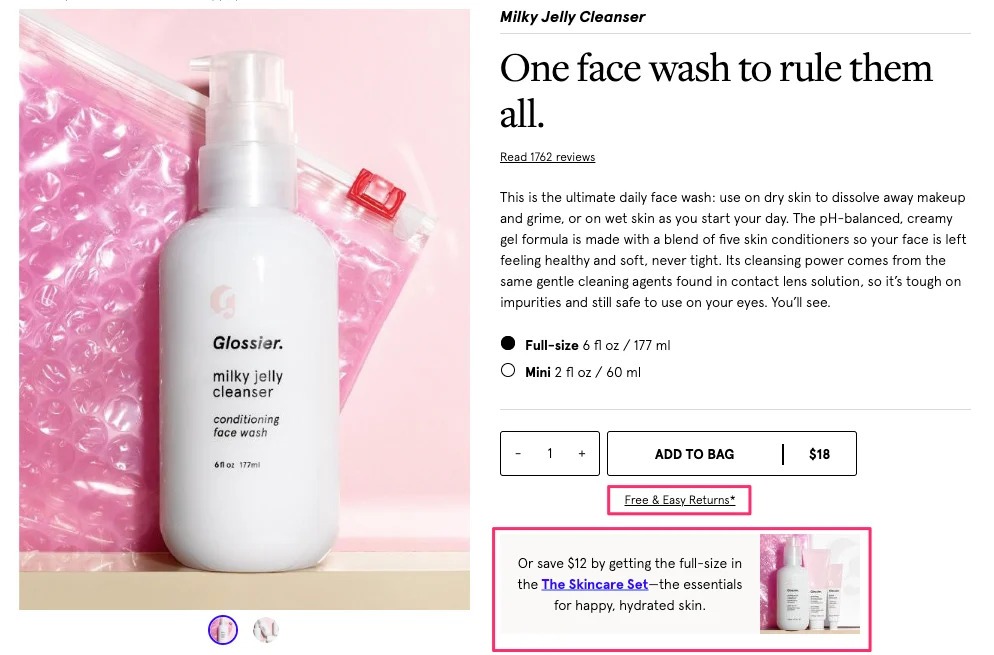
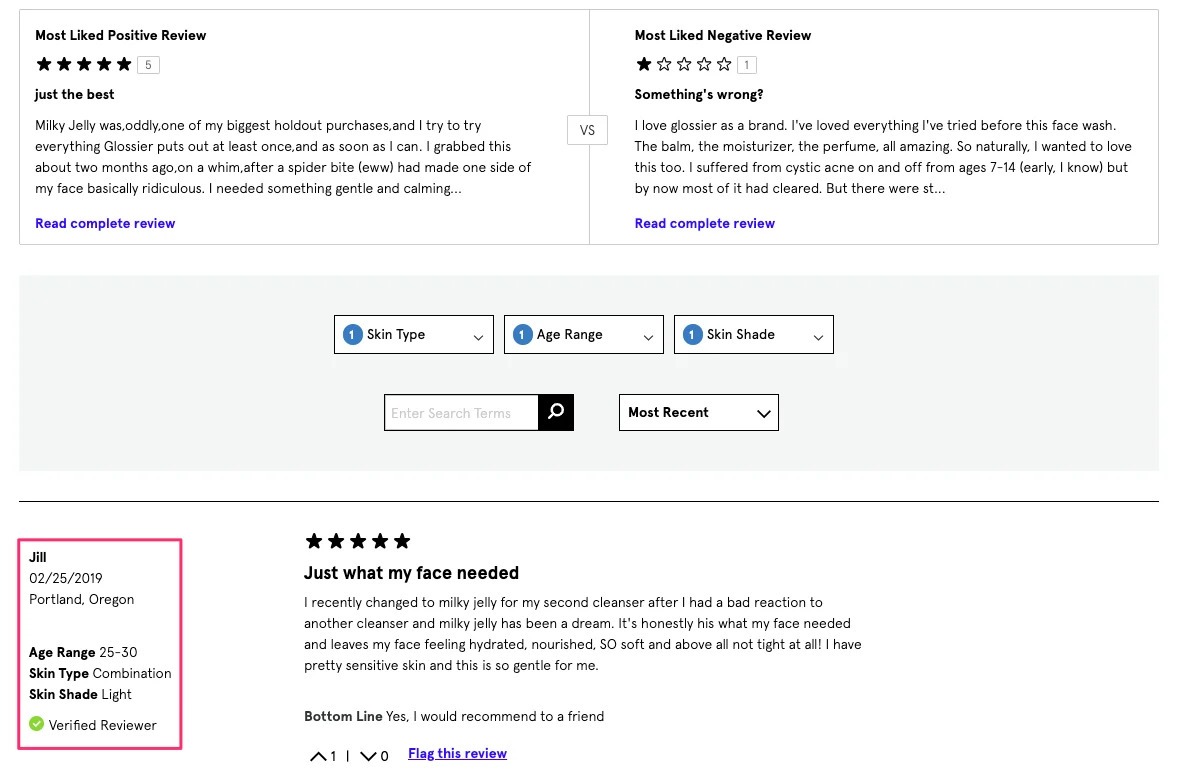
Reviews
Price
Available options
Key Features
Delivery
delivery availability and expected time
Returns
30-day returns subject to terms.
[Add to Cart]
Product Details
[Detailed specifications, materials, etc.]
Customer Reviews

[Verified customer reviews]
Frequently Asked Questions
[Common product and delivery questions]
This structure does more than make the page easier to read.
It gives search engines clearer information about the product while giving customers the information they need to evaluate the purchase.
This is where ecommerce SEO is often misunderstood.
Optimising the website product page and optimising the product feed should not be treated as two completely separate activities.
Google Merchant Center uses product attributes such as title, description, price, availability, brand, and images to match products with relevant queries and support Shopping ads and free listings.
The product information also needs to remain consistent.
If important product information does not match, the business can face display issues or product disapprovals.
Google specifically requires price and availability information to match between the product data, landing page and structured data.
The same principle applies to product titles.
Google recommends specific, accurate titles that clearly identify the product and include useful distinguishing characteristics where relevant, such as brand, colour or size.
The goal is not to fill the product page with keywords.
It is to make the product understandable to both the search engine and the customer.
A strong product page should answer three questions quickly:
Can Google understand what this product is?
Can the customer understand why it is relevant?
Does the page give the customer enough confidence to buy?
That is why product-page optimisation should sit between SEO, Shopping visibility, ecommerce and conversion optimisation, rather than being treated as a keyword exercise.
And importantly, Google itself recommends creating rich product description pages with accurate and comprehensive information because this helps shoppers understand products and make more confident purchasing decisions
Customers do not always begin with a product search.
They may start with a question, comparison or buying problem.
Useful content can capture that earlier demand and guide customers towards relevant categories and products.
For example:
Buying Guide → Category → Product
Technical problems can limit the value of everything else.
Crawlability, indexation, site speed, canonical URLs, structured data and faceted navigation all influence whether search engines can discover the pages that matter.
Technical SEO should therefore serve a commercial purpose:
Make valuable pages discoverable and make the customer journey easier.
One of the biggest mistakes businesses make is treating rankings as the primary measure of SEO performance.
We look at what happens after visibility.
A #1 ranking for an irrelevant keyword can be less valuable than a #5 ranking for a high-intent product search.
Where possible, SEO should also connect with ecommerce analytics, CRM data, Customer Acquisition Cost, Customer Lifetime Value and margin.
This changes the question from:
"How many keywords did we rank for?"
to:
"How much valuable customer demand did organic search create?"
The strongest strategies start with the business rather than the keyword list.
Start with revenue goals, priority categories, customers, markets, margins and customer value.
Identify product, category, brand, comparison and problem-based searches across Arabic and English.
Ask what is actually limiting organic growth.
Is the problem poor visibility?
Weak category coverage?
Technical indexation?
Low-quality traffic?
Poor conversion?
Weak measurement?
The answer determines where expertise should be applied.
Not every page deserves the same investment.
A useful framework is:
Search Demand × Commercial Value × Ranking Opportunity × Conversion Potential
Improve the technical foundation and the pages with the strongest commercial opportunity.
Track:
Visibility → Traffic → Conversion → Revenue → Customer Value
The objective is not to optimise everything.
It is to solve the constraint that is preventing the business from reaching its next stage of growth.
Growing ecommerce businesses frequently underestimate how much value can be lost through poor SEO prioritisation.
Common mistakes include:
More indexed pages do not automatically create more organic revenue.
The right question is always:
Does this page help the business capture valuable demand?
Ecommerce SEO improves an online store so its products, categories and supporting content can appear for relevant searches and generate qualified organic traffic, customers and revenue.
It can help UAE ecommerce businesses capture existing search demand, improve product discovery and reduce dependence on paid acquisition over time.
Yes.
Businesses need to consider Arabic and English search behaviour, local intent, AED pricing, delivery expectations and regional seasonality.
It can reduce reliance on paid acquisition for some types of demand over time.
However, SEO should complement rather than automatically replace paid media.
It depends on search demand, commercial value, ranking opportunity and conversion potential.
Look beyond rankings.
Track qualified organic traffic, conversions, organic revenue, new customers and customer value.
Calibrate Commerce does not approach ecommerce SEO as a race to rank for the largest number of keywords.
We start with a different question:
Which search demand can create the greatest commercial value for the business?
Our approach is:
Diagnose → Map Demand → Prioritise → Optimise → Measure → Scale
The expertise required depends on the constraint.
If technical visibility is limiting growth, technical SEO may need to come first.
If the website ranks but customers are not converting, ecommerce and conversion optimisation may be more important.
If priority categories lack visibility, search-demand and content strategy may be the constraint.
If organic revenue cannot be measured properly, analytics needs to come first.
Calibrate Commerce brings together SEO, ecommerce, analytics, performance marketing, CRO, content, AEO, AI and customer experience around the business problem.
The team is not brought in simply to produce more SEO activity.
The right expertise is applied to the constraint that matters most.
The objective is to connect:
Search Demand → Ecommerce Experience → Conversion → Revenue
Ecommerce SEO should not be judged by how many keywords a website ranks for.
The more important question is whether organic search is helping the business attract the right customers and generate valuable revenue.
For UAE ecommerce brands, that means understanding local search behaviour, prioritising valuable demand, building the right commercial pages and measuring what happens after the click.
Successful ecommerce businesses do not grow simply because they appear in more searches.
They grow by identifying the right commercial constraint, applying the right expertise and turning customer demand into sustainable value.
At Calibrate Commerce, the goal is not simply to win more searches.
It is to turn relevant search demand into sustainable revenue.